Before PhotonLink's ECOC unveiling, the measurement boundary is still open
Coherent plans a September 21 PhotonLink unveiling. Its announcement leaves engineers with questions about configurations, workloads, and energy accounting.
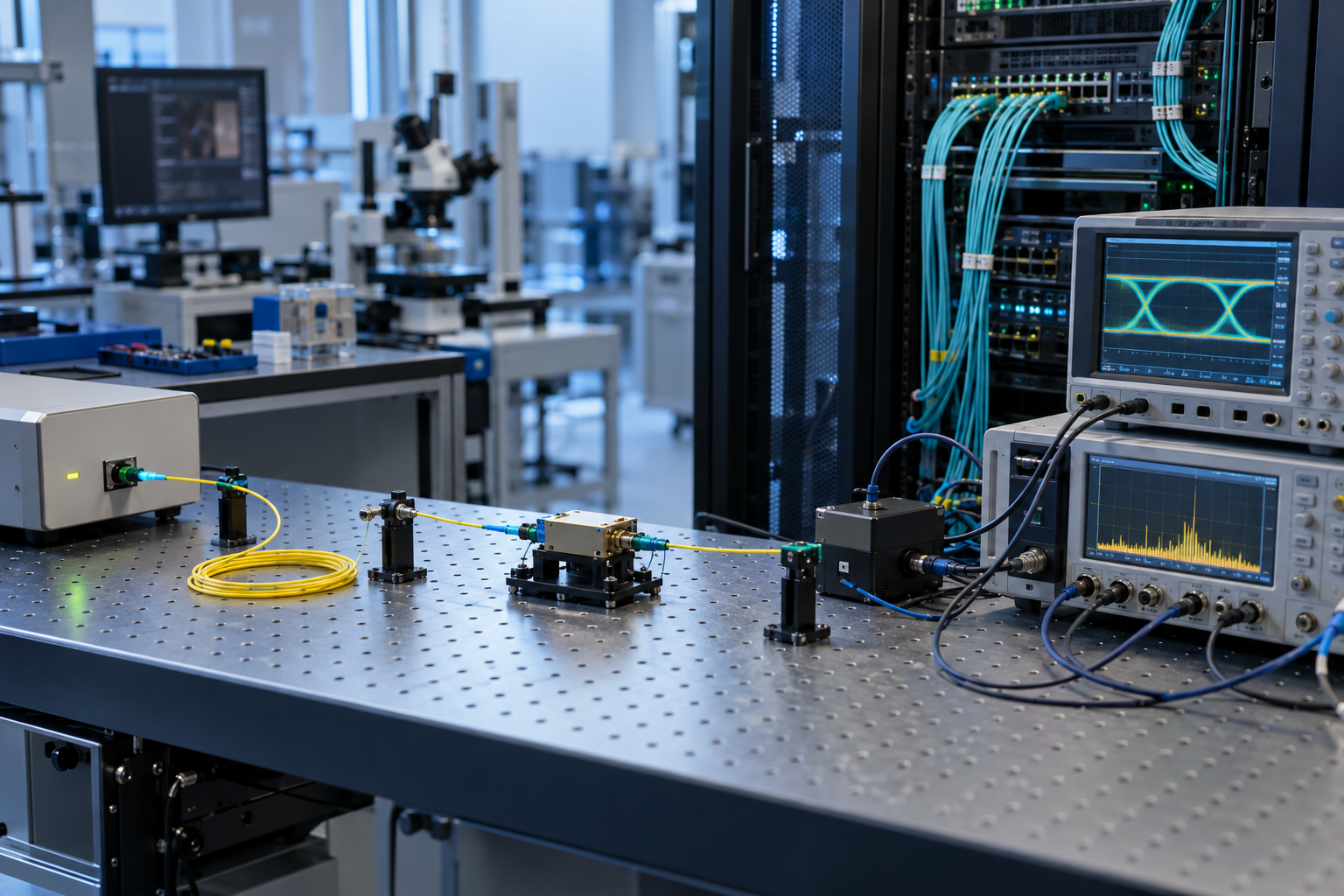
Coherent plans to unveil its PhotonLink integrated-optics platform at the European Conference on Optical Communication (ECOC) on September 21, 2026. The company's August 25 announcement describes a platform spanning light generation, beam shaping, transmission, detection, and conversion back to an electrical signal for an accelerator or switch chip.
That is a statement about intended platform scope. It is not yet a disclosed product configuration, independent performance result, or complete energy measurement. Until the presentation and technical materials arrive, the useful question is not whether PhotonLink is “end to end,” but where each claimed result begins and ends.
A chain is not one measurement
The announced chain contains several functions that can be packaged and powered differently: a laser source, optical conditioning, transmission, receivers, conversion electronics, and the electrical interface to the host chip. Coherent also says the platform supports co-packaged optics (CPO), near-packaged optics (NPO), and other integration forms. Those arrangements do not necessarily share the same electrical reach, thermal design, service model, or power boundary. The described function is moving data between electronic chips; the release does not report computation performed optically.
The distinction matters because a component result can be technically strong without describing the whole switch or computing system. An optical engine's energy per transmitted bit may exclude the switch application-specific integrated circuit, host serializer/deserializer, cooling, control electronics, or other supporting loads.
The OIF co-packaging framework makes this accounting visible in its own estimates: it identifies included engine-side electrical interfaces, clock-and-data recovery, photonic components, and the laser source, while excluding the switch side. PhotonLink may use a different boundary. The unveiling needs to state it.
What a measurable reveal would provide
A useful technical disclosure would connect a named configuration to a defined link and workload. That includes line rate, reach, modulation, error correction, latency, bit-error conditions, optical power, and the electrical equipment included in the energy figure. It should also identify whether the result comes from a component, packaged module, switch, rack, or modeled future system.
Comparison needs the same care. A 2026 Journal of Lightwave Technology paper on co-packaged and pluggable optics says reported savings vary with what is counted and which technology generation is used. Its abstract argues for a system-level approach. The paper is useful context for the measurement problem; it is not evidence about PhotonLink.
Throughput also needs a denominator. Aggregate platform capacity, capacity per package, and useful application traffic are different quantities. Reliability and serviceability deserve similar separation: a design that moves optics closer to a hot switch chip can change replacement and thermal-management choices even when its link efficiency improves.
CPO and NPO create different operating questions
Co-packaged optics places optical engines close to the host switching or computing silicon. Near-packaged optics keeps the optical assembly nearby but more physically distinct. Both aim to shorten demanding electrical paths, but they can distribute heat, cabling, laser delivery, and replaceable parts differently.
That makes a broad platform announcement useful only when each result is attached to its integration form. A link budget measured for one package cannot automatically describe another. The same is true for maintenance: replacing a pluggable transceiver, an optical engine mounted beside a switch chip, and a remote laser source are different operating procedures with different failure domains.
Three boundaries to draw
An engineering review can keep the announcement disciplined by drawing three nested boxes.
For a proposed comparison, start with the optical engine: conversion, photonic integrated circuit, and directly attached electronics. Expand to the complete link, accounting for the laser wherever it sits, fiber, the receiver at the other end, and both electrical interfaces. Finally, count the hardware system under evaluation—a switch, accelerator fabric, rack, or cluster—including host silicon, memory where relevant, cooling, control, and traffic behavior. Record each load once; these are accounting choices, not fixed packaging definitions.
Each metric belongs to one box. Energy per bit at the engine is not switch power. Link latency is not application completion time. Manufactured component yield is not deployed service availability. A valid presentation can report any of these, but readers need the box before they can compare the number.
The comparison baseline must also be contemporary and functionally equivalent. A new co-packaged design compared with an older pluggable generation may show a real improvement while leaving unanswered how it compares with current linear pluggable or retimed alternatives. Reach, modulation, error correction, port count, ambient conditions, and traffic pattern should stay aligned or be named as limitations.
What remains unknown before September 21
Coherent's announcement does not provide a product data sheet, list a purchasable configuration, identify a customer deployment, or disclose an independent test. It makes broad claims about bandwidth, performance, and energy efficiency without attaching public measurement conditions in the release.
The September 21 event may answer some of those questions. If it supplies only architecture and roadmap material, the correct conclusion will remain narrow: Coherent has organized multiple photonic technologies under a platform name and described the signal-chain territory it intends to cover.
For infrastructure readers, the post-event checklist is straightforward: identify the exact configuration, draw the physical and energy boundary, record the workload and comparator, and separate measured results from modeled scaling. Only then can “complete optical signal chain” become a testable systems claim rather than a description of portfolio breadth.
Sources & evidence
Source material checked Sep 14, 2026. Reporting and analysis distinguish documented facts from company claims.
- Coherent Corp. to unveil PhotonLink platform at ECOC on September 21, 2026 ↗Coherent
- OIF Co-Packaging Framework Document ↗OIF
- Data Center Switch Power Consumption Comparison Between Co-Packaged Optics and Pluggable Transceivers ↗IEEE Journal of Lightwave Technology
AI-assisted research and drafting. Approved for publication by Theo Linden on Sep 14, 2026.
Continue reading

Co-packaged optics brings an operating-model question to AI networking
The 2026 sampling, production and supply announcements make serviceability, energy boundaries and replacement responsibility central to evaluation.
Lightmatter's 1.6 Tbps-per-fiber sampling targets interconnect density
The March Passage announcement concerns data movement; its evaluation platform keeps measured bandwidth separate from efficiency targets.
NVIDIA puts Spectrum-X Photonics in production, with deployment evidence still separate
The May announcement advances co-packaged optical networking while leaving shipment timing and workload gains as distinct questions.